Everything You Need to Know About Atlas Shrugged
 Start edition | |
| Writer | Ayn Rand |
|---|---|
| Country | United States |
| Language | English |
| Genre |
|
| Published | October 10, 1957 |
| Publisher | Random House |
| Pages | 1,168 (first edition) |
| Awards | Prometheus Accolade – Hall of Fame 1983 |
| OCLC | 412355486 |
Atlas Shrugged is a 1957 novel by Ayn Rand. Her 4th and final novel, it was also her longest, and the one she considered to be her magnum opus in the realm of fiction writing.[one] Atlas Shrugged includes elements of science fiction, mystery, and romance, and information technology contains Rand's nearly all-encompassing statement of Objectivism in whatsoever of her works of fiction. The theme of Atlas Shrugged, every bit Rand described it, is "the role of man's heed in beingness". The book explores a number of philosophical themes from which Rand would subsequently develop Objectivism. In doing so, it expresses the advocacy of reason, individualism, and capitalism, and depicts what Rand saw to be the failures of governmental coercion.
The volume depicts a dystopian United States in which private businesses suffer nether increasingly burdensome laws and regulations. Railroad executive Dagny Taggart and her lover, steel magnate Hank Rearden, struggle against "looters" who desire to exploit their productivity. Dagny and Hank discover that a mysterious figure called John Galt is persuading other business leaders to abandon their companies and disappear every bit a strike of productive individuals against the looters. The novel ends with the strikers planning to build a new capitalist society based on Galt's philosophy of reason and individualism.
Atlas Shrugged received largely negative reviews after its 1957 publication, but achieved indelible popularity and ongoing sales in the following decades. The novel has been cited as an influence on a variety of libertarian and bourgeois thinkers and politicians. Afterwards several unsuccessful attempts to adapt the novel for film or television, a film trilogy based on it was released from 2011 to 2014, and two theatrical adaptations have also been staged.
Synopsis [edit]
Setting [edit]
Atlas Shrugged is ready in a dystopian United States at an unspecified time, in which the country has a "National Legislature" instead of Congress and a "Caput of State" instead of a President. The Usa appears to be approaching an economic collapse, with widespread shortages, business failures, and decreased productivity. Writer Edward Younkins said, "The story may be simultaneously described as anachronistic and timeless. The pattern of industrial organisation appears to be that of the late 1800s—the mood seems to be close to that of the depression-era 1930s. Both the social community and the level of technology remind i of the 1950s".[ii] Many early 20th-century technologies are available, just afterward technologies such as jet planes and computers are largely absent.[3] At that place is very little mention of historical people or events, non fifty-fifty major events such as World State of war II.[four] Aside from the United States, most countries are referred to equally "People'south States" that are implied to be either socialist or communist.[2] [5]
Plot [edit]

Dagny Taggart, the operating vice-president of Taggart Transcontinental railroad, keeps the company going amidst a sustained economic depression. As economical conditions worsen and government enforces statist controls on successful businesses, people echo the cryptic phrase "Who is John Galt?" which means: "Don't ask questions nobody can answer";[6] or more broadly, "Why bother?". Her brother Jim, the railroad's president, seems to make irrational decisions, such as buying from Orren Boyle's unreliable Associated Steel. Dagny is as well disappointed to discover that the Argentine billionaire Francisco d'Anconia, her childhood friend and first love, is risking his family unit'southward copper visitor by constructing the San Sebastián copper mines, even though Mexico will probably nationalize them. Despite the risk, Jim and Boyle invest heavily in a railway for the region while ignoring the Rio Norte Line in Colorado, where entrepreneur Ellis Wyatt has discovered large oil reserves. Mexico nationalizes the mines and railroad line, but the mines are discovered to be worthless. To recoup the railroad'south losses, Jim influences the National Brotherhood of Railroads to prohibit contest in prosperous areas such as Colorado. Wyatt demands that Dagny supply acceptable rails to his wells before the ruling takes effect.
In Philadelphia, self-made steel magnate Hank Rearden develops Rearden Metallic, an blend lighter and stronger than conventional steel. Dagny opts to use Rearden Metal in the Rio Norte Line, condign the first major customer for the production. After Hank refuses to sell the metal to the State Science Institute, a government enquiry foundation run past Dr. Robert Stadler, the Institute publishes a report condemning the metallic without identifying bug with information technology. As a result, many pregnant organizations boycott the line. Although Stadler agrees with Dagny's complaints nigh the unscientific tone of the report, he refuses to override it. To protect Taggart Transcontinental from the boycott, Dagny decides to build the Rio Norte Line as an contained company named the John Galt Line.
Hank is unhappy with his manipulative wife Lillian, only feels obliged to stay with her. He is attracted to Dagny, and when he joins her for the inauguration of the John Galt Line, they become lovers. On a vacation, Hank and Dagny discover an abandoned factory with an incomplete but revolutionary motor that runs on atmospheric static electricity. They begin searching for the inventor, and Dagny hires scientist Quentin Daniels to reconstruct the motor. Withal, a serial of economically harmful directives are issued past Wesley Mouch, a former Rearden lobbyist who betrayed Hank in return for a job leading a government agency. Wyatt and other important business leaders quit and disappear, leaving their industries to failure.
From conversations with Francisco, Dagny and Hank realize he is hurting his copper visitor intentionally, although they do not understand why. When the government imposes a directive that forbids employees from leaving their jobs and nationalizes all patents, Dagny violates the law by resigning in protest. To proceeds Hank's compliance, the government blackmails him with threats to publicize his affair with Dagny. Subsequently a major disaster in i of Taggart Transcontinental's tunnels, Dagny returns to work. On her return, she receives discover that Quentin Daniels is also quitting in protestation, and she rushes across the country to convince him to stay.

On her way to Daniels, Dagny meets a hobo with a story that reveals the motor was invented and abased by an engineer named John Galt, who is the inspiration for the common saying. When she chases later Daniels in a private plane, she crashes and discovers the secret behind the disappearances of business leaders: Galt is leading a strike of "the men of the mind". She has crashed in their hiding place, an isolated valley known as Galt'south Gulch. As she recovers from her injuries, the strikers explain their motives, and she learns that the strikers include Francisco and many prominent people, such every bit her favorite composer, Richard Halley, and infamous pirate Ragnar Danneskjöld. Dagny falls in love with Galt, who asks her to join the strike.
Reluctant to carelessness her railroad, Dagny leaves Galt's Gulch, but finds the government has devolved into dictatorship. Francisco finishes sabotaging his mines and quits. After he helps stop an armed takeover of Hank'southward steel factory, Francisco convinces Hank to bring together the strike. Galt follows Dagny to New York, where he hacks into a national radio broadcast to evangelize a three-hour oral communication that explains the novel'south theme and Rand's Objectivism.[7] The authorities capture Galt, unsuccessfully attempt to persuade him to lead the restoration of the country's economy, and torture him when he refuses. The authorities collapses, and the novel closes as Galt announces that the strikers can rejoin the world.
History [edit]
Context and writing [edit]

Rand'southward stated goal for writing the novel was "to show how desperately the earth needs prime movers and how viciously it treats them" and to portray "what happens to the earth without them".[8] The core idea for the book came to her after a 1943 telephone conversation with her friend Isabel Paterson, who asserted that Rand owed it to her readers to write fiction near her philosophy. Rand replied, "What if I went on strike? What if all the artistic minds of the globe went on strike?"[ix] Rand then began Atlas Shrugged to describe the morality of rational self-interest,[10] by exploring the consequences of a strike past intellectuals refusing to supply their inventions, art, business leadership, scientific research, or new ideas to the residual of the world.[11]
Rand began the offset draft of the novel on September two, 1946.[12] She initially idea information technology would exist like shooting fish in a barrel to write and completed quickly, merely as she considered the complexity of the philosophical issues she wanted to address, she realized it would have longer.[13] After ending a contract to write screenplays for Hal Wallis and finishing her obligations for the film adaptation of The Fountainhead, Rand was able to piece of work full-time on the novel that she tentatively titled The Strike. By the summer of 1950, she had written 18 chapters;[14] by September 1951, she had written 21 chapters and was working on the concluding of the novel'south three sections.[15]
Equally Rand completed new chapters, she read them to a circle of young confidants who had begun gathering at her abode to discuss philosophy. This group included Nathaniel Branden, his married woman Barbara Branden, Barbara's cousin Leonard Peikoff, and economist Alan Greenspan.[16] Progress on the novel slowed considerably in 1953, when Rand began working on Galt's lengthy radio address. She spent more than two years completing the speech, finishing it on October thirteen, 1955.[17] The remaining capacity proceeded more than quickly, and past November 1956 Rand was ready to submit the well-nigh-completed manuscript to publishers.[18]
Atlas Shrugged was Rand's terminal completed work of fiction. It marked a turning point in her life—the cease of her career as a novelist and the beginning of her office as a popular philosopher.[19] [20]
Influences [edit]

Rand biographer Anne Heller traces some ideas that would go into Atlas Shrugged dorsum to a never-written novel that Rand outlined when she was a student at Saint petersburg State University. The futuristic story featured an American heiress luring the most talented men away from a mostly communist Europe. The heiress would have had an assistant called Eddie Willers, the name of Dagny's banana in Atlas Shrugged.[21]
To depict the industrial setting of Atlas Shrugged, Rand conducted inquiry on the American railroad and steel industries. She toured and inspected a number of industrial facilities, such as the Kaiser Steel plant,[22] visited facilities of the New York Key Railroad,[23] [24] and fifty-fifty briefly operated a locomotive on the Twentieth Century Limited.[25] Rand as well used previous research she did for a proposed (but never completed) screenplay well-nigh the development of the atomic bomb, including her interviews of J. Robert Oppenheimer, which influenced the character Robert Stadler and the novel'southward depiction of the development of "Projection Ten".[26]
Rand's descriptions of Galt's Gulch were based on the town of Ouray, Colorado, which Rand and her husband visited in 1951 when they were relocating from Los Angeles to New York.[15] Other details of the novel were affected past the experiences and comments of her friends. For example, her portrayal of leftist intellectuals (such as the characters Balph Eubank and Simon Pritchett) was influenced by the college experiences of Nathaniel and Barbara Branden,[27] and Alan Greenspan provided information on the economics of the steel manufacture.[28]
Libertarian writer Justin Raimondo described similarities between Atlas Shrugged and Garet Garrett's 1922 novel The Driver, which is about an idealized industrialist named Henry Galt, who is a transcontinental railway owner trying to improve the world and fighting against government and socialism.[29] Raimondo believed the before novel influenced Rand's writing in ways she failed to acknowledge, although there was no "give-and-take-for-word plagiarism" and The Driver was published four years earlier Rand emigrated to the United States.[30] Journalist Jeff Walker echoed Raimondo's comparisons in his book The Ayn Rand Cult and listed The Driver as one of several unacknowledged precursors to Atlas Shrugged.[31] In contrast, Chris Matthew Sciabarra said he "could not notice whatever prove to link Rand to Garrett"[32] and considered Raimondo's claims to be "unsupported".[33] Liberty mag editor R. W. Bradford said Raimondo made an unconvincing comparing based on a coincidence of names and common literary devices.[34]
Publishing history [edit]

Random House CEO Bennett Cerf oversaw the novel's publication in 1957.
Due to the success of Rand's 1943 novel The Fountainhead, she had no trouble alluring a publisher for Atlas Shrugged. This was a contrast to her previous novels, which she had struggled to place. Even before she began writing it, she had been approached by publishers interested in her adjacent novel. However, her contract for The Fountainhead gave the first selection to its publisher, Bobbs-Merrill Visitor. After reviewing a partial manuscript, they asked her to discuss cuts and other changes. She refused, and Bobbs-Merrill rejected the book.[35]
Hiram Hayden, an editor she liked who had left Bobbs-Merrill, asked her to consider his new employer, Random Firm. In an early on discussion about the difficulties of publishing a controversial novel, Random House president Bennett Cerf proposed that Rand should submit the manuscript to multiple publishers simultaneously and inquire how they would respond to its ideas, and then she could evaluate who might best promote her piece of work. Rand was impressed by the bold proposition and by her overall conversations with them. After speaking with a few other publishers from about a dozen who were interested, Rand decided multiple submissions were not needed; she offered the manuscript to Random House. Upon reading the portion Rand submitted, Cerf declared it a "corking book" and offered Rand a contract. Information technology was the first fourth dimension Rand had worked with a publisher whose executives seemed enthusiastic near one of her books.[36]
When the completed manuscript exceeded 600,000 words, Cerf asked Rand to make cuts, only backed off when she compared the idea to cutting the Bible.[37] With 1168 pages in the first edition, Atlas Shrugged is Rand'south longest published book.[38]
Random House published the novel on October 10, 1957. The initial impress run was 100,000 copies. The first paperback edition was published by New American Library in July 1959, with an initial run of 150,000.[39] A 35th-anniversary edition was published by Eastward. P. Dutton in 1992, with an introduction by Rand's heir, Leonard Peikoff.[40] The novel has been translated into more than than 30 languages.[a]
Title and chapters [edit]
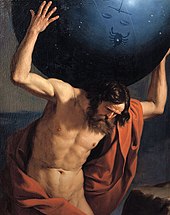
The novel was named afterward the mythological Atlas.
The working title of the novel was The Strike, but Rand thought this championship would reveal the mystery chemical element of the novel prematurely.[11] She was pleased when her husband suggested Atlas Shrugged, previously the championship of a single chapter, for the volume.[42] The title is a reference to Atlas, a Titan in Greek mythology, who is described in the novel equally "the behemothic who holds the world on his shoulders".[b] The significance of this reference appears in a conversation in which Francisco d'Anconia asks Rearden what advice he would requite Atlas if "the greater [the Titan's] effort, the heavier the world bore downward on his shoulders". With Rearden unable to reply, d'Anconia gives his own advice: "To shrug".[44]
The novel is divided into 3 parts consisting of 10 chapters each. Each part is named in laurels of ane of Aristotle's laws of logic: "Non-Contradiction" subsequently the law of noncontradiction; "Either-Or", which is a reference to the police of excluded eye; and "A Is A" in reference to the constabulary of identity.[45] Each chapter besides has a title; Atlas Shrugged is the simply one of Rand'south novels to use chapter titles.[46]
Themes [edit]
Philosophy [edit]
The story of Atlas Shrugged dramatically expresses Rand's ethical egoism, her advocacy of "rational selfishness", whereby all of the principal virtues and vices are applications of the role of reason every bit man's basic tool of survival (or a failure to apply information technology): rationality, honesty, justice, independence, integrity, productiveness, and pride. Rand's characters frequently personify her view of the archetypes of various schools of philosophy for living and working in the globe. Robert James Bidinotto wrote, "Rand rejected the literary convention that depth and plausibility demand characters who are naturalistic replicas of the kinds of people we meet in everyday life, uttering everyday dialogue and pursuing everyday values. Simply she also rejected the notion that characters should be symbolic rather than realistic."[47] and Rand herself stated, "My characters are never symbols, they are merely men in sharper focus than the audience can see with unaided sight. ... My characters are persons in whom certain human attributes are focused more sharply and consistently than in average human beings".[47]
In addition to the plot's more obvious statements nigh the significance of industrialists to society, and the sharp dissimilarity to Marxism and the labor theory of value, this explicit conflict is used by Rand to describe wider philosophical conclusions, both implicit in the plot and via the characters' own statements. Atlas Shrugged caricatures fascism, socialism, communism, and any state intervention in guild, as allowing unproductive people to "leech" the hard-earned wealth of the productive, and Rand contends that the result of any private's life is purely a office of their ability, and that any private could overcome adverse circumstances, given power and intelligence.[48]
Sanction of the victim [edit]
The concept "sanction of the victim" is divers past Leonard Peikoff equally "the willingness of the good to endure at the hands of the evil, to have the role of sacrificial victim for the 'sin' of creating value".[49] Accordingly, throughout Atlas Shrugged, numerous characters are frustrated by this sanction, as when Hank Rearden appears duty-spring to support his family, despite their hostility toward him; subsequently, the principle is stated by Dan Conway: "I suppose somebody's got to exist sacrificed. If it turned out to be me, I accept no right to complain". John Galt farther explains the principle: "Evil is impotent and has no power but that which we allow it extort from us", and, "I saw that evil was impotent ... and the only weapon of its triumph was the willingness of the skillful to serve it".[fifty]
Government and business [edit]
Rand's view of the ideal government is expressed by John Galt: "The political system we volition build is contained in a single moral premise: no man may obtain any values from others by resorting to physical strength", whereas "no rights tin exist without the correct to translate one's rights into reality—to think, to work and to continue the results—which means: the correct of property".[51] Galt himself lives a life of laissez-faire capitalism.[52]
In the world of Atlas Shrugged, social club stagnates when independent productive agencies are socially demonized for their accomplishments. This is in agreement with an excerpt from a 1964 interview with Playboy magazine, in which Rand states: "What we have today is not a capitalist society, simply a mixed economy—that is, a mixture of freedom and controls, which, past the before long ascendant trend, is moving toward dictatorship. The action in Atlas Shrugged takes place at a time when gild has reached the stage of dictatorship. When and if this happens, that volition be the time to proceed strike, but non until and so".[53]
Rand also depicts public choice theory, such that the linguistic communication of altruism is used to pass legislation nominally in the public interest (e.thou., the "Anti-Dog-Eat-Dog Rule", and "The Equalization of Opportunity Pecker"), just more to the short-term do good of special interests and authorities agencies.[54]
Holding rights and individualism [edit]
Rand's heroes continually oppose "parasites", "looters", and "moochers" who demand the benefits of the heroes' labor. Edward Younkins describes Atlas Shrugged as "an apocalyptic vision of the last stages of disharmonize between two classes of humanity—the looters and the not-looters. The looters are proponents of high revenue enhancement, big labor, government ownership, authorities spending, authorities planning, regulation, and redistribution".[55]
"Looters" are Rand's delineation of bureaucrats and authorities officials, who confiscate others' earnings by the implicit threat of forcefulness ("at the point of a gun"). Some officials execute government policy, such as those who confiscate one land's seed grain to feed the starving citizens of another; others exploit those policies, such as the railroad regulator who illegally sells the railroad's supplies for his own profit. Both use force to take property from the people who produced or earned information technology.
"Moochers" are Rand'south delineation of those unable to produce value themselves, who demand others' earnings on behalf of the needy, but resent the talented upon whom they depend, and appeal to "moral right" while enabling the "lawful" seizure by governments.
The character Francisco d'Anconia indicates the function of "looters" and "moochers" in relation to money: "And then you recall that money is the root of all evil? ... Accept you ever asked what is the root of money? Money is a tool of exchange, which can't be unless in that location are goods produced and men able to produce them. ... Money is not the tool of the moochers, who claim your product by tears, or the looters who have it from you by force. Money is fabricated possible but by the men who produce."[56]
Genre [edit]
The novel includes elements of mystery, romance, and scientific discipline fiction.[57] [58] Rand referred to Atlas Shrugged equally a mystery novel, "not about the murder of man's body, but near the murder—and rebirth—of man's spirit".[59] Still, when asked by motion-picture show producer Albert South. Ruddy if a screenplay could focus on the beloved story, Rand agreed and reportedly said, "That's all it ever was".[58] Technological progress and intellectual breakthroughs in scientific theory appear in Atlas Shrugged, leading some observers to classify it in the genre of scientific discipline fiction.[60] Fictional inventions such as Galt'south motor, Rearden Metal, and Project X (a sonic weapon) are important to the plot.[61] Science fiction historian John J. Pierce describes it equally a "romantic suspense novel" that is "at least a deadline case" of science fiction,[62] specifically libertarian science fiction based on its political themes.[63] The novel'due south focus on philosophical bug, including ethics and metaphysics, marks it every bit a philosophical novel.[64] [65]
Reception [edit]
Sales [edit]

Atlas Shrugged debuted at number 13 on The New York Times Best Seller list three days afterwards its publication. It peaked at number 3 on December viii, 1957, and was on the list for 22 consecutive weeks.[66] By 1984, its sales had exceeded 5 meg copies.[67] Sales of Atlas Shrugged increased following the financial crunch of 2007–2008. The novel'southward sales in 2009 exceeded 500,000 copies,[68] and information technology sold 445,000 copies in 2011.[69] As of 2019, the novel had sold nine 1000000 copies.[70]
Contemporary reviews [edit]
Atlas Shrugged was generally disliked by critics. Rand scholar Mimi Reisel Gladstein afterwards wrote that "reviewers seemed to vie with each other in a competition to devise the cleverest put-downs"; one chosen information technology "execrable claptrap", while another said it showed "remorseless hectoring and prolixity".[71] In the Saturday Review, Helen Aggravate Woodward said that the novel was written with "dazzling virtuosity" but was "shot through with hatred".[72] In The New York Times Book Review, Granville Hicks similarly said the volume was "written out of hate".[73] The reviewer for Time magazine asked: "Is it a novel? Is it a nightmare? Is it Superman – in the comic strip or the Nietzschean version?"[74] In National Review, Whittaker Chambers called Atlas Shrugged "sophomoric"[75] and "remarkably featherbrained",[76] and said it "can be chosen a novel merely by devaluing the term".[75] Chambers argued against the novel's implicit endorsement of disbelief and said the implicit message of the novel is akin to "Hitler's National Socialism and Stalin's brand of Communism": "To a gas chamber—get!"[77]
There were some positive reviews. Richard McLaughlin, reviewing the novel for The American Mercury, described it as a "long overdue" polemic against the welfare state with an "exciting, suspenseful plot", although unnecessarily long. He drew a comparison with the antislavery novel Uncle Tom'due south Cabin, maxim that a "skillful polemicist" did not need a refined literary style to have a political bear upon.[78] Journalist and book reviewer John Chamberlain, writing in the New York Herald Tribune, institute Atlas Shrugged satisfying on many levels: every bit science fiction, as a "philosophical detective story", and as a "profound political parable".[79]
Influence and legacy [edit]
Atlas Shrugged has attracted an energetic and committed fan base of operations. Each year, the Ayn Rand Institute donates 400,000 copies of works by Rand, including Atlas Shrugged, to high schoolhouse students.[59] Co-ordinate to a 1991 survey washed for the Library of Congress and the Volume of the Calendar month Club, Atlas Shrugged was mentioned amongst the books that made the almost departure in the lives of 17 out of five,000 Volume-of-the-Calendar month gild members surveyed, which placed the novel betwixt the Bible and Thousand. Scott Peck's The Road Less Traveled.[lxxx] Modernistic Library's 1998 nonscientific online poll of the 100 best novels of the 20th century found Atlas rated No. ane, although it was not included on the list chosen by the Modern Library board of authors and scholars.[81] [82] The 2018 PBS Great American Read television serial plant Atlas Shrugged rated number xx out of 100 novels,[83] based on a YouGov survey "asking Americans to proper noun their most-loved novel".[84]
Rand's impact on contemporary libertarian idea has been considerable. The championship of one libertarian magazine, Reason: Free Minds, Free Markets, is taken directly from John Galt, the hero of Atlas Shrugged, who argues that "a free mind and a complimentary market are corollaries". In a tribute written on the 20th ceremony of the novel's publication, libertarian philosopher John Hospers praised it as "a supreme achievement, guaranteed of immortality".[85] In 1997, the libertarian Cato Institute held a joint conference with The Atlas Society, an Objectivist organization, to celebrate the 40th anniversary of the publication of Atlas Shrugged.[86] At this event, Howard Dickman of Reader's Digest stated that the novel had "turned millions of readers on to the ideas of liberty" and said that the book had the of import message of the readers' "profound right to exist happy".[86]
Rand's former business concern partner and lover Nathaniel Branden expressed differing views of Atlas Shrugged. He was initially quite favorable to it, and even after he and Rand ended their relationship, he still referred to information technology in an interview equally "the greatest novel that has ever been written", although he constitute "a few things one can quarrel with in the book".[87] Even so, in 1984 he argued that Atlas Shrugged "encourages emotional repression and self-disowning" and that Rand's works contained contradictory messages. He criticized the potential psychological impact of the novel, stating that John Galt'south recommendation to respond to wrongdoing with "contempt and moral condemnation" clashes with the view of psychologists who say this only causes the wrongdoing to repeat itself.[88]
The Austrian Schoolhouse economist Ludwig von Mises admired the unapologetic elitism he saw in Rand's work. In a letter to Rand written a few months after the novel's publication, he said it offered "a cogent analysis of the evils that plague our society, a substantiated rejection of the ideology of our self-styled 'intellectuals' and a pitiless unmasking of the insincerity of the policies adopted by governments and political parties ... You have the courage to tell the masses what no politician told them: you are inferior and all the improvements in your conditions which you simply take for granted you owe to the efforts of men who are better than you."[89]
Murray Rothbard, another Austrian Schoolhouse economist, wrote a alphabetic character to Rand in 1958 in which he praised the book as "an infinite treasure house" and "non merely the greatest novel ever written, [only] one of the very greatest books ever written, fiction or nonfiction".[ninety] Rothbard shortly distanced himself from Rand due to various disagreements in philosophy, and in the early 1960s he wrote a satirical ane human action play titled Mozart Was a Crimson that spoofed Rand (as the character Carson Sand) and the novel (as Sand'south book The Forehead of Zeus).[91]
In the years immediately following the novel'southward publication, many American conservatives, such every bit William F. Buckley, Jr., strongly disapproved of Rand and her Objectivist bulletin.[92] In addition to the strongly critical review past Whittaker Chambers, Buckley solicited a number of critical pieces: Russell Kirk called Objectivism an "inverted religion",[92] Frank Meyer accused Rand of "calculated cruelties" and her message, an "arid subhuman image of human",[92] and Garry Wills regarded Rand a "fanatic".[92]
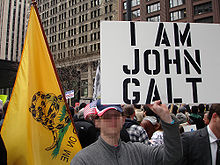
A protester's sign at a 2009 Tea Political party rally refers to the character John Galt.
In the 21st century, the novel was referred to more positively by some conservatives. In 2005, Republican Congressman Paul Ryan said that Rand was "the reason I got into public service", and he required his staff members to read Atlas Shrugged,[93] although in 2012 he said his supposed devotion to Rand was "an urban legend".[94] In 2006, Clarence Thomas, an associate justice of the Supreme Court of the United States, cited Atlas Shrugged every bit amid his favorite novels.[95] Post-obit the financial crisis of 2007–2008, bourgeois commentators suggested the book equally a warning against a socialistic reaction to the crisis. Conservative commentators Neal Boortz,[96] Glenn Brook, and Blitz Limbaugh[97] offered praise of the book on their respective radio and television programs. In January 2009, conservative writer Stephen Moore wrote an article in The Wall Street Journal titled "Atlas Shrugged From Fiction to Fact in 52 Years",[98] and two months later Republican Congressman John Campbell said, "People are starting to experience like we're living through the scenario that happened in Atlas Shrugged."[99] Outside of the United states, the novel has been cited as an influence by politicians such as Siv Jensen in Kingdom of norway[100] and Ayelet Shaked in Israel.[101]
References to Atlas Shrugged have appeared in a variety of other popular entertainments. In the first season of the drama series Mad Men, Bert Cooper urges Don Draper to read the book, and Don'due south sales pitch tactic to a client indicates he has been influenced past the strike plot.[102] Less positive mentions of the novel occur in episodes of the animated comedies Futurama, where information technology appears amid the library of books flushed down to the sewers to be read only by grotesque mutants, and South Park, where a newly literate grapheme gives upward on reading after experiencing Atlas Shrugged.[103] The critically acclaimed 2007 video game BioShock is widely considered to be a response to Atlas Shrugged. The story depicts a society that has collapsed due to Objectivism, and significant characters in the game owe their naming to Rand's work, which the game'southward creator Ken Levine constitute "actually fascinating".[104]
In 2013, it was appear that Galt's Gulch, a settlement for libertarian devotees named for John Galt's safe oasis, would be established near Santiago in Chile,[105] just the projection collapsed amid accusations of fraud.[106] [107]
Awards [edit]
Atlas Shrugged was a finalist for the US National Book Honor for Fiction in 1958, but lost to The Wapshot Chronicle by John Cheever.[108] In 1983, it was one of the first two books given the Prometheus Awards' Hall of Fame Honor for libertarian science fiction, alongside The Moon Is a Harsh Mistress past Robert Heinlein.[109]
Adaptations [edit]
Film [edit]
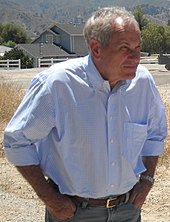
A motion picture adaptation of Atlas Shrugged was in "development hell" for nearly xl years.[110] In 1972, Albert Due south. Ruddy approached Rand to produce a cinematic accommodation. Rand insisted on having last script approving, which Ruddy refused to give her, thus preventing a deal. In 1978, Henry and Michael Jaffe negotiated a bargain for an eight-hr Atlas Shrugged goggle box miniseries on NBC. Screenwriter Stirling Silliphant wrote the adaptation and obtained approval from Rand on the terminal script. When Fred Silverman became president of NBC in 1979, the project was scrapped.[111]
Rand, a quondam Hollywood screenwriter herself, began writing her own screenplay, but died in 1982 with only one-tertiary of it finished. Her heir, Leonard Peikoff, sold an option to Michael Jaffe and Ed Snider. Peikoff would not approve the script they wrote, and the deal fell through. In 1992, investor John Aglialoro paid Peikoff over $one million for an option with full artistic control.[111] Two new scripts – one by screenwriter Benedict Fitzgerald and some other by Peikoff's married woman, Cynthia Peikoff – were deemed inadequate, and Aglialoro refunded early investors in the project.[112]
In 1999, nether Aglialoro'south sponsorship, Scarlet negotiated a bargain with Turner Network Tv set (TNT) for a four-hr miniseries, but the project was killed later on TNT merged with AOL Fourth dimension Warner. After the TNT deal roughshod through, Howard and Karen Baldwin obtained the rights while running Philip Anschutz'due south Crusader Entertainment. The Baldwins left Crusader to form Baldwin Entertainment Group in 2004 and took the rights to Atlas Shrugged with them. Michael Burns of Lions Gate Entertainment approached the Baldwins to fund and distribute Atlas Shrugged.[111] A draft screenplay was written by James V. Hart[113] and rewritten by Randall Wallace,[114] only was never produced.
Atlas Shrugged: Part I [edit]

In May 2010, Brian Patrick O'Toole and Aglialoro wrote a screenplay, intent on filming in June 2010. Stephen Polk was fix to direct.[115] Nonetheless, Polk was fired and main photography began on June 13, 2010, under the direction of Paul Johansson and produced by Harmon Kaslow and Aglialoro.[116] This resulted in Aglialoro'due south retention of his rights to the belongings, which were set to expire on June 15, 2010. Filming was completed on July 20, 2010,[117] and the movie was released on April 15, 2011.[118] Taylor Schilling played Dagny Taggart and Grant Bowler played Hank Rearden.[119]
The film was met with a generally negative reception from professional person critics. Review aggregator Rotten Tomatoes gives the film a score of 12% based on 52 reviews, with an average score of 3.8 out of 10.[120] The moving-picture show had under $five million in full box office receipts,[118] considerably less than the estimated $20 1000000 invested by Aglialoro and others.[121] The poor box office and critical reception made Aglialoro reconsider his plans for the balance of the trilogy,[122] but other investors convinced him to continue.[123]
Atlas Shrugged: Function Two [edit]
On February 2, 2012, Kaslow and Aglialoro announced they had raised $16 million to fund Atlas Shrugged: Part Two.[124] Principal photography began on April two, 2012;[125] the producers hoped to release the pic before the Us presidential election in November.[126] Because the bandage for the kickoff film had not been contracted for the entire trilogy, different actors were bandage for all the roles.[127] Samantha Mathis played Dagny, with Jason Beghe every bit Hank and Esai Morales as Francisco d'Anconia.[128]
The film was released on October 12, 2012, without a special screening for critics.[129] It earned $1.7 million on 1012 screens for the opening weekend, which at that fourth dimension ranked as the 109th worst opening for a movie in wide release.[130] Critical response was highly negative; Rotten Tomatoes gives the motion-picture show a 4% rating based on 23 reviews, with an average score of 3.ii out of 10.[131] The film's final box office total was $three.3 one thousand thousand.[130]
Atlas Shrugged: Part Iii: Who Is John Galt? [edit]
The tertiary part in the series, Atlas Shrugged Function Iii: Who Is John Galt?, was released on September 12, 2014.[132] Dagny was played past Laura Regan, with Rob Morrow every bit Hank, Kristoffer Polaha as John Galt, and Joaquim de Almeida as Francisco. The motion-picture show opened on 242 screens and grossed $461,179 on its opening weekend; the terminal box function full was $851,690.[133] It was reviewed unfavorably by critics, holding a 0% at Rotten Tomatoes based on 10 reviews, with an average score of i.8 out of 10.[134]
Phase [edit]
Atlas Shrugged has been adapted twice as phase plays in German. In 2013, Stefan Bachmann, director of the Schauspiel Köln in Cologne, staged Der Streik (The Strike), a four-hour accommodation co-written by Bachmann and Jens Gross. Bachmann had begun the adaptation eight years earlier, only the theaters he worked for prior to Schauspiel Köln were dismissive of the thought.[135] In January 2021, director Nicolas Stemann presented a iii-hour musical accommodation, besides titled Der Streik , in Zürich, Switzerland. Stemann'south version of the story from the novel is presented as a story within a story beingness staged past a "Church of Ayn Rand" that is associated with the alt-right and white supremacy.[136]
See also [edit]
- Objectivism and libertarianism
Notes [edit]
- ^ Co-ordinate to the Ayn Rand Constitute, Atlas Shrugged has been translated into Albanian, Bulgarian, Chinese, Czech, Danish, Dutch, Finnish, French, Georgian, High german, Greek, Hebrew, Hungarian, Icelandic, Italian, Japanese, Kazakh, Korean, Marathi, Mongolian, Norwegian, Polish, Portuguese, Romanian, Russian, Serbian, Slovak, Spanish, Swedish, Turkish, and Ukrainian.[39] [41]
- ^ In ancient myths, Atlas supported the sky, non the earth. Artistic depictions of Atlas property a sphere (representing the sky) led to a after misconception that he held the earth.[43]
References [edit]
- ^ Rand 1997, p. 704.
- ^ a b Younkins, Edward Westward. "Atlas Shrugged: Ayn Rand'southward Philosophical and Literary Masterpiece". In Younkins 2007, pp. nine–10.
- ^ Hunt 1983, p. 85.
- ^ Hunt 1983, p. 86.
- ^ Hunt 1983, p. 82.
- ^ Rand 1995, p. 23.
- ^ Stolyarov II, K. "The Role and Essence of John Galt'southward Voice communication in Ayn Rand'southward Atlas Shrugged". In Younkins 2007, p. 99.
- ^ Rand 1997, p. 392.
- ^ Heller 2009, p. 165.
- ^ Rand 1986, p. 150.
- ^ a b Branden 1986, p. 291.
- ^ Heller 2009, p. 201.
- ^ Heller 2009, p. 202.
- ^ Heller 2009, p. 229.
- ^ a b Heller 2009, p. 235.
- ^ Branden 1986, pp. 254–255.
- ^ Heller 2009, pp. 260, 268.
- ^ Heller 2009, p. 271.
- ^ Younkins 2007, p. i.
- ^ Gladstein 2000, p. 28.
- ^ Heller 2009, pp. 48–49.
- ^ Burns 2009, p. 126.
- ^ Heller 2009, p. 206.
- ^ Burns 2009, p. 125.
- ^ Heller 2009, p. 212.
- ^ Burns 2009, p. 107.
- ^ Heller 2009, p. 225.
- ^ Heller 2009, p. 242.
- ^ Raimondo 2008, pp. 237–241.
- ^ Raimondo 2008, p. 243.
- ^ Walker 1999, pp. 305–307.
- ^ Sciabarra 2013, p. 419.
- ^ Sciabarra 1999, p. 11.
- ^ Bradford 1994, pp. 57–58.
- ^ Ralston, Richard Due east. "Publishing Atlas Shrugged". In Mayhew 2009, pp. 123–124.
- ^ Ralston, Richard E. "Publishing Atlas Shrugged". In Mayhew 2009, pp. 124–127.
- ^ Heller 2009, p. 279.
- ^ Lipp, Ronald F. "Atlas and Art". In Younkins 2007, p. 143
- ^ a b Ralston, Richard E. "Publishing Atlas Shrugged". In Mayhew 2009, p. 130.
- ^ Gladstein 1999, p. 129.
- ^ "Strange Editions" (PDF). Ayn Rand Plant. Archived (PDF) from the original on June 21, 2021. Retrieved June 21, 2021.
- ^ Burns 2009, p. 149.
- ^ Hansen 2004, p. 127.
- ^ Minsaas, Kirsti. "Ayn Rand's Recasting of Ancient Myths in Atlas Shrugged". In Younkins 2007, pp. 131–132.
- ^ Younkins, Edward W. "Atlas Shrugged: Ayn Rand's Philosophical and Literary Masterpiece". In Younkins 2007, p. fifteen.
- ^ Seddon, Fred. "Diverse Levels of Pregnant in the Affiliate Titles of Atlas Shrugged". In Younkins 2007, p. 47.
- ^ a b Bidinotto 2011.
- ^ Peikoff, Leonard. "Introduction to the 35th Anniversary Edition". In Rand 1992, pp. half dozen–8.
- ^ Leonard Peikoff, "The Philosophy of Objectivism" lecture series (1976), Lecture 8. [1]
- ^ Rand 1992, p. 1048.
- ^ Rand 1992, p. 1062.
- ^ Gladstein 1999, p. 54.
- ^ "Ayn Rand interviewed past Alvin Toffler". Playboy Magazine. discoveraynrand.com. 1964. Archived from the original on March 12, 2009. Retrieved April 12, 2009.
- ^ Caplan, Bryan. "Atlas Shrugged and Public Choice: The Obvious Parallels". In Younkins 2007, pp. 215–224.
- ^ Younkins, Edward W. "Atlas Shrugged: Ayn Rand's Philosophical and Literary Masterpiece". In Younkins 2007, p. 10.
- ^ Rand 1992, pp. 410–413.
- ^ Gladstein 1999, p. 42
- ^ a b McConnell 2010, p. 507
- ^ a b Rubin 2007.
- ^ Hunt 1983, pp. fourscore–98.
- ^ Riggenbach, Jeff. "Atlas Shrugged as a Science Fiction Novel". In Younkins 2007, p. 124.
- ^ Pierce 1989, pp. 158–159.
- ^ Pierce 1989, p. 163.
- ^ Gotthelf, Alan. "Galt's Oral communication in Five Sentences (and Twoscore Questions)". In Mayhew 2009, p. 394n6.
- ^ Salmieri, Gregory. "Discovering Atlantis: Atlas Shrugged 's Demonstration of a New Moral Philosophy". In Mayhew 2009, p. 401.
- ^ "History of Atlas Shrugged". Ayn Rand Plant. Archived from the original on February 10, 2014. Retrieved Apr 18, 2012.
- ^ Branden 1986, p. 299.
- ^ "Atlas Shrugged Sets a New Record!". Ayn Rand Constitute. January 21, 2010. Archived from the original on November 26, 2011. Retrieved January 12, 2009.
- ^ "Atlas Shrugged Even so Flying Off Shelves". Ayn Rand Institute. February fourteen, 2012. Retrieved January ane, 2015.
- ^ Cocks 2020, p. 29.
- ^ Gladstein 1999, p. 118
- ^ Woodward 1957, p. 25.
- ^ Hicks 1957, p. v.
- ^ "Solid Gold Dollar Sign". Fourth dimension. Oct 14, 1957. p. 128.
- ^ a b Chambers 1957, p. 595.
- ^ Chambers 1957, p. 594.
- ^ Chambers 1957, p. 596.
- ^ McLaughlin 1958, pp. 144–146.
- ^ Chamberlain, John (October 6, 1957). "Ayn Rand's Political Parable and Thundering Melodrama". The New York Herald Tribune. p. half dozen.1.
- ^ "Bible Ranks 1 of Books That Inverse Lives". Los Angeles Times. December 2, 1991.
- ^ Freund, Charles Paul (Oct 1998). "Netbrow". Reason. p. 17.
- ^ "100 Best Novels". Random House. Archived from the original on Feb iii, 2011. Retrieved February 1, 2011.
- ^ "The Great American Read: Results". PBS. Archived from the original on June 6, 2021. Retrieved July 1, 2021.
- ^ "The Great American Read: About". PBS. Archived from the original on May viii, 2021. Retrieved July 1, 2021.
- ^ Hospers, John (Oct 1977). "Atlas Shrugged: A Twentieth Anniversary Tribute". Libertarian Review. vi (half dozen): 41–43.
- ^ a b "Hundreds Gather to Gloat Atlas Shrugged". Cato Policy Report. November–Dec 1997. Archived from the original on April 20, 2009. Retrieved April 14, 2009.
- ^ "Pause Free! An Interview with Nathaniel Branden" (PDF). Reason. October 1971. p. 17.
- ^ Branden 1984
- ^ von Mises, Ludwig. Letter dated January 23, 2958. Quoted in Hülsmann, Jörg Guido (2007). Mises: The Terminal Knight of Liberalism. Auburn, Alabama: The Ludwig von Mises Institute. p. 996. ISBN978-1-933550-18-3.
- ^ Burns 2009, pp. 145, 182.
- ^ Sciabarra 2000, p. 165.
- ^ a b c d Edwards, Lee (May 5, 2010). "Starting time Principles Serial Report #29 on Political Idea". The Heritage Foundation . Retrieved August 8, 2013.
- ^ Axle 2010.
- ^ Costa 2012.
- ^ Thomas 2007, pp. 62, 187
- ^ "How Well-nigh A Mini Atlas Shrugged? – Nealz Nuze On". Boortz.com. Dec 18, 2008. Archived from the original on February v, 2010. Retrieved September 12, 2009.
- ^ Beck, Yaron (March 15, 2009). "Is Rand Relevant?". Wall Street Journal.
- ^ Moore, Stephen (January 9, 2009). "Atlas Shrugged': From Fiction to Fact in 52 Years". The Wall Street Journal. Archived from the original on Jan 4, 2015. Retrieved January 14, 2014.
- ^ Barnes 2009.
- ^ Zeveloff 2015.
- ^ White 2010, pp. 79–94.
- ^ Sciabarra 2004.
- ^ Perry 2006.
- ^ Bodzin, Steven (March 2014). "Libertarians Plan to Sit Out the Coming Plummet of America...in Republic of chile". Mother Jones.
- ^ Hutchinson, Brian (September 26, 2014). "'Freedom and liberty' non enough to save Galt's Gulch, Chile libertarian community from bureaucracy and internal dissent". National Post. Archived from the original on February 9, 2015.
- ^ Cheadle, Harry (September 22, 2014). "Atlas Mugged: How a Libertarian Paradise in Chile Brutal Autonomously". Vice . Retrieved Baronial 22, 2016.
- ^ "Atlas Shrugged". National Book Foundation. Archived from the original on February 25, 2021. Retrieved June 28, 2021.
- ^ "Prometheus Awards". Libertarian Futurist Society. Archived from the original on May 22, 2021. Retrieved June 28, 2021.
- ^ Britting, Jeff. "Bringing Atlas Shrugged to Film". In Mayhew 2009, p. 195.
- ^ a b c Brown 2007.
- ^ Carter 2014, pp. 75–77.
- ^ McClintock 2006.
- ^ Fleming 2007.
- ^ Fleming, Mike (May 26, 2010). "'Atlas Shrugged' Rights Holder Sets June Production Start Whether Or Non Stars Align". Deadline.com. Archived from the original on May 29, 2010. Retrieved May 28, 2010.
- ^ Murty, Govindini (July 21, 2010). "Exclusive: LFM Visits the Gear up of Atlas Shrugged + Manager Paul Johansson'southward First Interview Well-nigh the Film". Libertas Film Magazine. Archived from the original on August one, 2010. Retrieved Baronial 26, 2010.
- ^ Kay, Jeremy (July 26, 2010). "Product Wraps on Atlas Shrugged Part 1". Screen Daily. Archived from the original on July 30, 2010. Retrieved July 29, 2010.
- ^ a b Carter 2014, p. 89.
- ^ Carter 2014, p. 85.
- ^ "Atlas Shrugged Part I". Rotten Tomatoes. Flixster. Retrieved June 21, 2021.
- ^ Weigel 2011.
- ^ Keegan 2011.
- ^ Carter 2014, pp. 90–91.
- ^ Fundamental 2012
- ^ DeSapio 2012
- ^ Carter 2014, p. 91
- ^ Carter 2014, p. 93
- ^ Carter 2014, p. 92
- ^ Carter 2014, p. 95
- ^ a b Knegt 2013
- ^ "Atlas Shrugged: Role 2". Rotten Tomatoes . Retrieved June 21, 2021.
- ^ Bond, Paul (March 26, 2014). "'Atlas Shrugged: Who Is John Galt?' Sets Sept. 12 Release Date (Exclusive)". The Hollywood Reporter . Retrieved September 21, 2014.
- ^ "Atlas Shrugged Part III: Who is John Galt?". The Numbers . Retrieved June 21, 2021.
- ^ "Atlas Shrugged: Who is John Galt?". Rotten Tomatoes . Retrieved June 21, 2021.
- ^ Brühwiler 2021, pp. 220–221.
- ^ Brühwiler 2021, pp. 221–222.
Works cited [edit]
- Barnes, Anita (March four, 2009). "Congressman: We're Living in Atlas Shrugged". The Washington Independent. Archived from the original on February 12, 2021. Retrieved June 27, 2021.
- Beam, Christopher (December 17, 2010). "The Trouble with Liberty". New York. Archived from the original on October 23, 2020. Retrieved June 27, 2021.
- Bidinotto, Robert James (April 5, 2011). "Atlas Shrugged every bit Literature". The Atlas Society. Archived from the original on March 8, 2021. Retrieved October 10, 2017.
- Bradford, R. Westward. (May 1994). "Was Ayn Rand a Plagiarist?" (PDF). Freedom. Vol. seven, no. 4. pp. 56–58.
- Branden, Barbara (1986). The Passion of Ayn Rand. Garden Urban center, New York: Doubleday & Company. ISBN978-0-385-19171-5.
- Branden, Nathaniel (Fall 1984). "The Benefits and Hazards of the Philosophy of Ayn Rand: A Personal Argument". Journal of Humanistic Psychology. 24 (four): 29–64. doi:10.1177/0022167884244004. S2CID 144772216.
- Brown, Kimberly (January 14, 2007). "Ayn Rand No Longer Has Script Approval". New York Times . Retrieved June 21, 2009.
- Brühwiler, Claudia Franziska (2021). Out of a Grey Fog: Ayn Rand's Europe (Kindle ed.). Lanham, Maryland: Lexington Books. ISBN978-1-79363-686-7.
- Burns, Jennifer (2009). Goddess of the Market place: Ayn Rand and the American Right. New York: Oxford Academy Press. ISBN978-0-nineteen-532487-7.
- Carter, Joan (2014). "The History of the Atlas Shrugged Movie Trilogy". In Kelley, David (ed.). Atlas Shrugged: The Novel, the Films, the Philosophy. The Atlas Club. ISBN978-1-5010-5924-7.
- Chambers, Whittaker (December 8, 1957). "Big Sister is Watching You". National Review. pp. 594–596.
- Cocks, Nick, ed. (2020). Questioning Ayn Rand: Subjectivity, Political Economy, and the Arts. Palgrave Studies in Literature, Culture and Economics (Kindle ed.). Cham, Switzerland: Palgrave Macmillan. ISBN978-iii-030-53072-three.
- Costa, Robert (Apr 26, 2012). "Ryan Shrugged: Representative Paul Ryan Debunks an 'Urban Fable'". National Review. Archived from the original on October 29, 2013. Retrieved June 6, 2013.
- DeSapio, Scott (Apr two, 2012). "Atlas Shrugged Role 2 Begins Principal Photography". Atlas Shrugged Movie. Atlas Productions. Retrieved August 17, 2019.
- Fleming, Michael (September 4, 2007). "Vadim Perelman to Direct 'Atlas'". Variety . Retrieved June 21, 2009.
- Gladstein, Mimi Reisel (1999). The New Ayn Rand Companion. Westport, Connecticut: Greenwood Printing. ISBN978-0-313-30321-0.
- Gladstein, Mimi Reisel (2000). Atlas Shrugged: Manifesto of the Mind. Twayne's Masterwork Studies series. New York: Twayne Publishers. ISBN978-0-8057-1638-2.
- Hansen, William (2004). Handbook of Classical Mythology. Santa Barbara, California: ABC-CLIO. ISBN978-one-57607-226-four.
- Heller, Anne C. (2009). Ayn Rand and the World She Made. New York: Doubleday. ISBN978-0-385-51399-9.
- Hicks, Granville (October xiii, 1957). "A Parable of Cached Talents". The New York Times Book Review. pp. 4–5.
- Hunt, Robert (1983). "Science Fiction for the Age of Inflation: Reading Atlas Shrugged in the 1980s". In Slusser, George E.; Rabkin, Eric Southward. & Scholes, Robert (eds.). Coordinates: Placing Scientific discipline Fiction and Fantasy . Carbondale, Illinois: Southern Illinois University Press. pp. 80–98. ISBN978-0-8093-1105-7.
- Keegan, Rebecca (April 26, 2011). "'Atlas Shrugged' Producer: 'Critics, You Won.' He's Going 'On Strike'". Los Angeles Times . Retrieved August 15, 2019.
- Knegt, Peter (January 4, 2013). "The five Biggest Disappointments at the 2012 Specialty Box Office". IndieWire . Retrieved August 17, 2019.
- Key, Peter (February six, 2012). "Atlas Shrugged: Part ii Movie Funded". Philadelphia Business concern Journal . Retrieved August 17, 2019.
- Mayhew, Robert, ed. (2009). Essays on Ayn Rand's Atlas Shrugged. Lanham, Maryland: Lexington Books. ISBN978-0-7391-2780-iii.
- McClintock, Pamela (April 26, 2006). "Lionsgate Shrugging". Variety. Archived from the original on Apr 29, 2009. Retrieved June 12, 2009.
- McConnell, Scott (2010). 100 Voices: An Oral History of Ayn Rand . New York: New American Library. ISBN978-0-451-23130-7.
- McLaughlin, Richard (January 1958). "The Lady Has a Message ...". The American Mercury. pp. 144–146.
- Pierce, John J. (1989). When World Views Collide: A Study in Imagination and Evolution. New York: Greenwood Press. ISBN978-0-313-25457-4.
- Perry, Douglass C. (May 26, 2006). "The Influence of Literature and Myth in Videogames". IGN. Archived from the original on February 24, 2021. Retrieved October seven, 2007.
- Raimondo, Justin (2008) [1993]. Reclaiming the American Right: The Lost Legacy of the Conservative Motility. Wilmington, Delaware: ISI Books. ISBN978-1-933859-60-vi.
- Rand, Ayn (1986) [1966]. Capitalism: The Unknown Ideal. Signet. ISBN978-0-451-14795-0.
- Rand, Ayn (1992) [1957]. Atlas Shrugged (35th ceremony ed.). New York: Dutton. ISBN978-0-525-94892-6.
- Rand, Ayn (1997). Harriman, David (ed.). Journals of Ayn Rand . New York: Dutton. ISBN978-0-525-94370-9.
- Rand, Ayn (1995). Berliner, Michael S (ed.). Messages of Ayn Rand. New York: Dutton. ISBN0-525-93946-6. OCLC 31412028.
- Rubin, Harriet (September 15, 2007). "Ayn Rand's Literature of Commercialism". The New York Times. Archived from the original on May 12, 2011. Retrieved April fifteen, 2011.
- Sciabarra, Chris Matthew (March–April 1999). "Books for Rand Studies". Full Context. xi (4): ix–xi. Archived from the original on October 26, 2020.
- Sciabarra, Chris Matthew (2000). Total Liberty: Toward a Dialectical Libertarianism. University Park, Pennsylvania: Pennsylvania Land University Press. p. 165. ISBN978-0-271-01830-0.
- Sciabarra, Chris Matthew (Fall 2004). "The Illustrated Rand" (PDF). The Journal of Ayn Rand Studies. 6 (ane): 1–xx. JSTOR 41560268. Archived (PDF) from the original on June 26, 2021. Retrieved Apr 15, 2011.
- Sciabarra, Chris Matthew (2013). Ayn Rand: The Russian Radical (2d ed.). University Park, Pennsylvania: Pennsylvania State Academy Press. ISBN978-0-271-06227-iii.
- Thomas, Clarence (2007). My Grandfather's Son: A Memoir . New York: Harper Perennial. ISBN978-0-06-056556-5.
- Walker, Jeff (1999). The Ayn Rand Cult. La Salle, Illinois: Open Court Publishing. ISBN0-8126-9390-6.
- Wang-naveen, Mala (January 5, 2016). "Er Ayn Rand en politikkens Darth Vader eller en glitrende ledestjerne?" [Is Ayn Rand a Darth Vader of Politics or a Sparkling Guiding Star?]. Aftenposten (in Norwegian). Archived from the original on Feb 22, 2021. Retrieved June 14, 2021.
- Weigel, David (March 3, 2011). "Libertarians Shrugged". Slate . Retrieved August 15, 2019.
- White, Robert (2010). "Endless Egoists: The Second-Hand Lives of Mad Men". In Carveth, Rod; South, James B. (eds.). Mad Men and Philosophy: Nothing Is as It Seems . Hoboken, New Bailiwick of jersey: John Wiley & Sons. ISBN978-0-470-60301-seven.
- Woodward, Helen Beal (October 12, 1957). "Not-Terminate Daydream". Saturday Review. p. 25.
- Younkins, Edward West., ed. (2007). Ayn Rand's Atlas Shrugged: A Philosophical and Literary Companion. Burlington, Vermont: Ashgate Publishing. ISBN978-0-7546-5533-vi.
- Zeveloff, Naomi (January 26, 2015). "Tin Ayelet Shaked Sell (Secular) Israel on the Far Right?". The Forward. Archived from the original on June iii, 2015. Retrieved June 28, 2021.
Further reading [edit]
- Branden, Nathaniel (1962). "The Moral Revolution in Atlas Shrugged". Who is Ayn Rand?. Book co-authored with Barbara Branden. New York: Random House. pp. 3–65. OCLC 313377536. Reprinted past The Objectivist Center as a booklet in 1999, ISBN ane-57724-033-2.
- Michalson, Karen (1999). "Who Is Dagny Taggart? The Epic Hero/ine in Disguise". In Gladstein, Mimi Reisel & Sciabarra, Chris Matthew (eds.). Feminist Interpretations of Ayn Rand. Re-reading the Canon. University Park, Pennsylvania: The Pennsylvania State University Press. ISBN978-0-534-57625-7.
- Wilt, Judith (1999). "On Atlas Shrugged". In Gladstein, Mimi Reisel & Sciabarra, Chris Matthew (eds.). Feminist Interpretations of Ayn Rand. Re-reading the Catechism. University Park, Pennsylvania: The Pennsylvania Country University Press. ISBN978-0-534-57625-vii.
External links [edit]
- Atlas Shrugged (Centennial Edition) at Google Books
- Atlas Shrugged on Goodreads
- Gratuitous Online CliffsNotes for Atlas Shrugged
- Page about Atlas Shrugged from the Ayn Rand Institute
- Timeline of major events in the novel
- Atlas Shrugged Essay Competition
- Atlas Shrugged study guide, themes, quotes, literary devices, educational activity resource
Source: https://en.wikipedia.org/wiki/Atlas_Shrugged
0 Response to "Everything You Need to Know About Atlas Shrugged"
Post a Comment